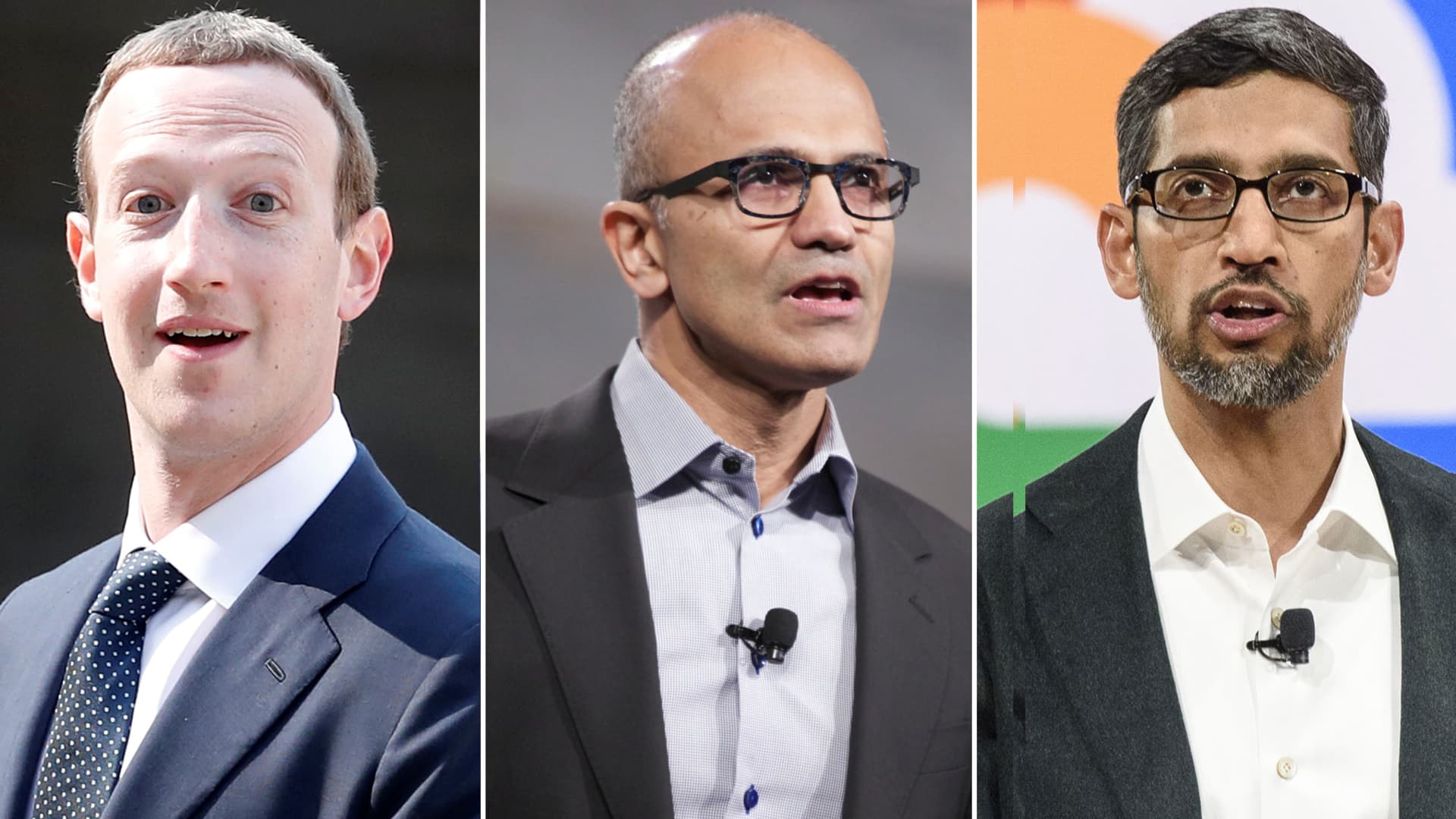
On the morning of April 23, Meta's chief people officer Janelle Gale sent an all-staff memo that laid out a straightforward proposition. Roughly 8,000 employees, representing 10 percent of the company's total workforce, would receive termination notices on May 20. The severance terms were unusually generous: 16 weeks of base pay as a floor, an additional two weeks for each year of tenure, and 18 months of COBRA health insurance subsidies. The stated rationale was not a revenue shortfall or a business model pivot. It was a budget reallocation. The same week, Meta confirmed its 2026 capital expenditure guidance at $115 billion to $135 billion, nearly double the $72 billion it deployed on artificial intelligence infrastructure in 2025. Gale's memo put the relationship plainly: the job cuts were part of "our continued effort to run the company more efficiently and to allow us to offset the other investments we are making."
Within hours of Meta's announcement, Microsoft disclosed something it had never done in its 51-year history. The company was offering a voluntary buyout to roughly 8,750 United States employees, approximately 7 percent of its domestic workforce. The offer was structured as an early retirement incentive requiring that the sum of an employee's age and years of service reach at least 70. Microsoft spent $37.5 billion in capital expenditures during the second quarter of 2026 alone, the overwhelming share of it directed at data center construction. CNBC reported that the twin disclosures prompted concern across Wall Street and among labor economists that the AI investment cycle has entered a phase in which major employers are formally treating human headcount as the variable that absorbs infrastructure cost growth.
The Capital Substitution Arithmetic
The individual figures for Meta and Microsoft command attention. The combined picture is harder to look away from. Alphabet, Microsoft, Meta, and Amazon are collectively on course to spend roughly $700 billion on AI infrastructure in 2026, according to Bloomberg analysts. That commitment is not reversible in a single budget cycle. Data center contracts are signed, GPU supply agreements are in place, and power purchase deals with utilities stretch years into the future. What adjusts quarter by quarter is how the operating budget is allocated across everything else, and labor is the single largest controllable line.
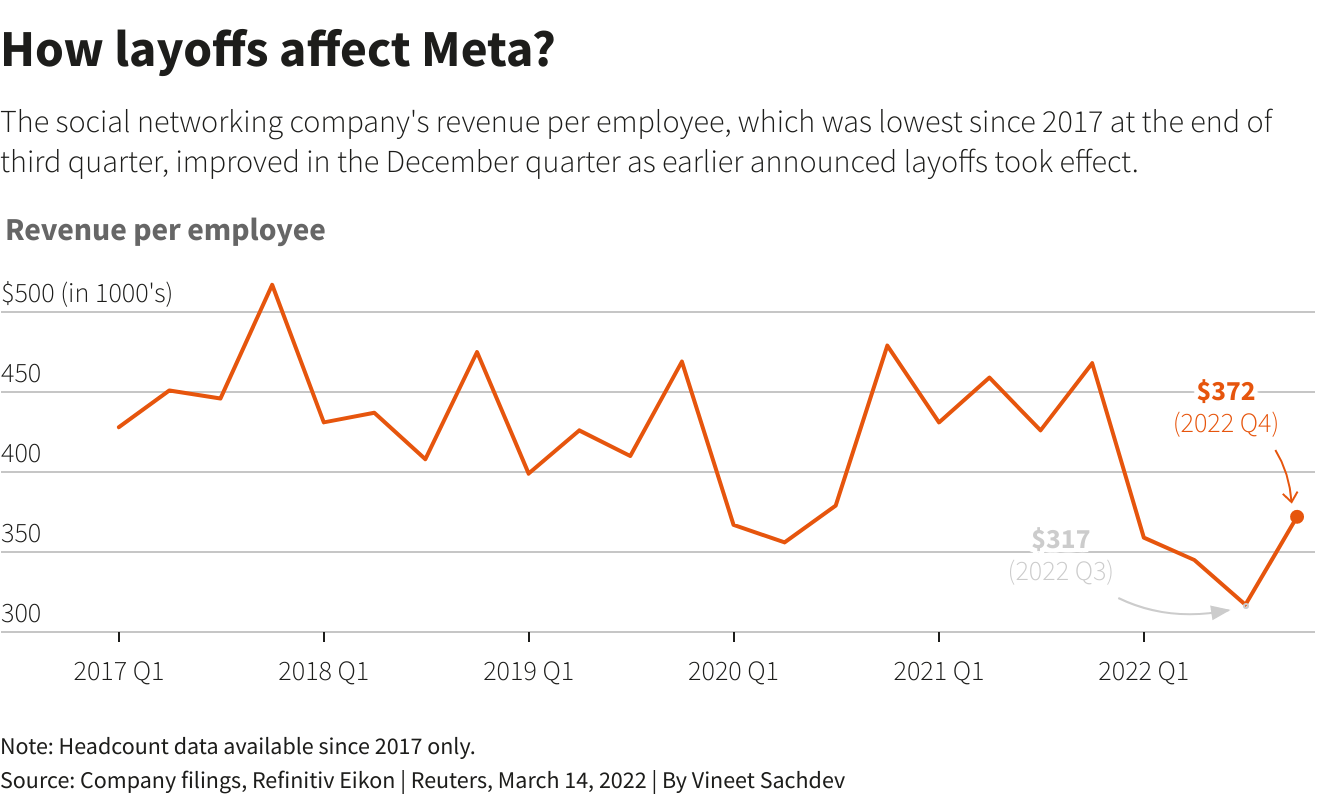
Meta's accounting makes the mechanism visible. Its full-year expense guidance runs from $162 billion to $169 billion, an increase driven almost entirely by infrastructure costs and the compensation demands of newly hired AI engineers, whose packages sit at the top of any technology pay scale. The company is simultaneously eliminating 8,000 roles concentrated in sales operations, technical program management, and enterprise support functions where its internal AI tooling has begun automating the core workflow. The decision to call the cuts an "offset" rather than a restructuring or a strategic pivot was deliberate. Meta is not changing what it makes. It is changing who does the work of running it.
Microsoft's voluntary program is structured differently but responds to the same pressure. The $37.5 billion quarterly capex rate is not compatible with unchanged operating margins unless cost grows more slowly elsewhere. Microsoft's approach avoids the legal and reputational exposure of a forced reduction: workers who accept the buyout do so on terms they have chosen, which limits severance liability and sidesteps the optics of mass terminations. The eligibility criteria targeting senior directors and below, combined with the age-plus-tenure threshold, concentrate the offer on the most expensive segment of the workforce. That segment maps almost precisely onto the knowledge worker layers that Copilot for Microsoft 365 was designed to augment. The Microsoft board's decision to extend a voluntary retirement offer for the first time in the company's history is, by any reasonable reading, a signal that management considers the transition structural rather than cyclical.
The Numbers Behind the Workforce Shift
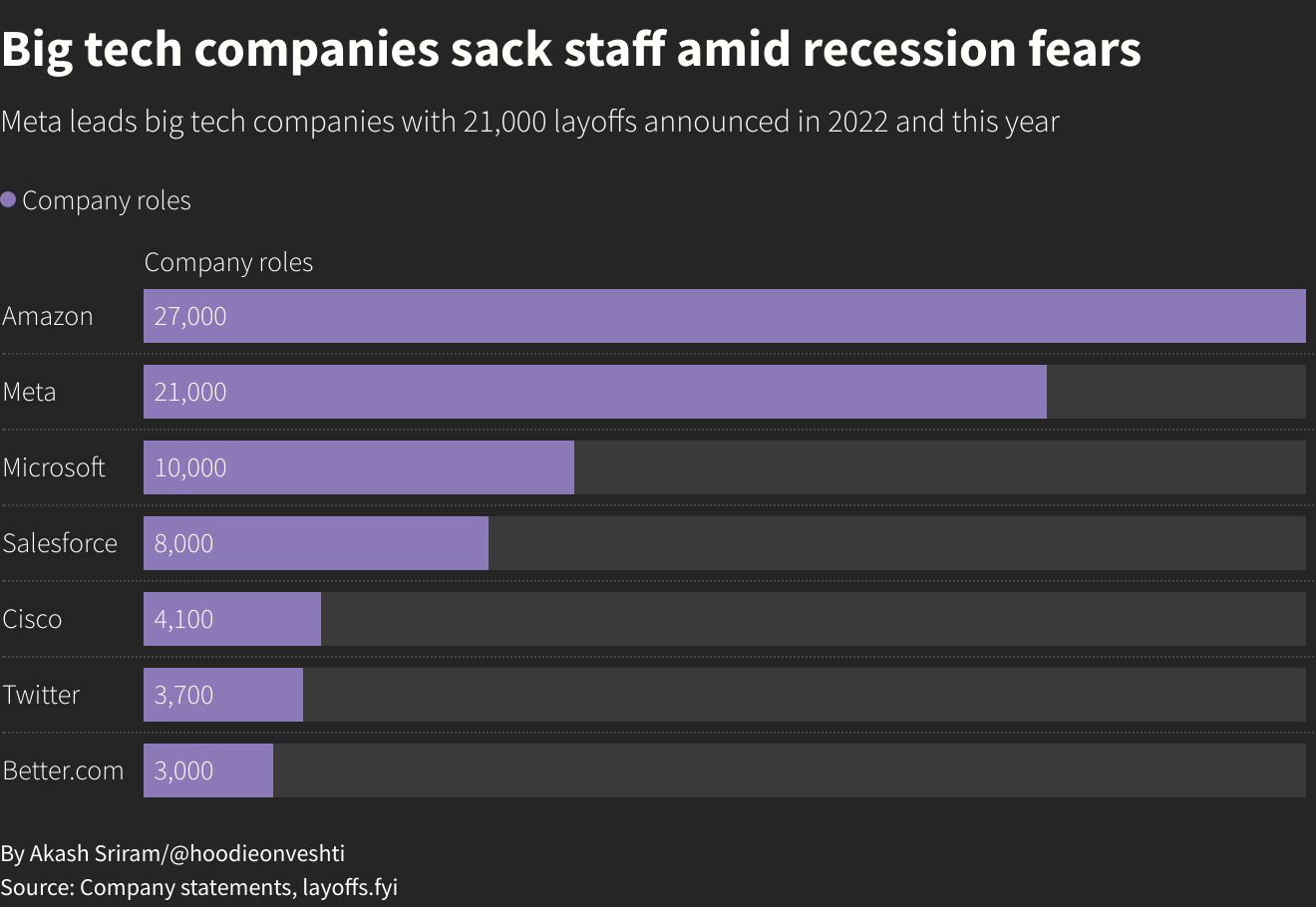
The two companies' combined 20,000 potential departures sit within a much larger trend. Layoffs.fyi counted 92,000 technology-sector job losses in the first four months of 2026, putting the full year on pace to exceed 2023's elevated total. Goldman Sachs estimated, in research cited by Fortune this month, that artificial intelligence is eliminating roughly 16,000 United States jobs per month across the economy as a whole. Bloomberg's labor analytics team projects that as many as 502,000 roles could face AI-driven substitution economy-wide before the end of 2026. The April disclosures from Meta and Microsoft suggest those projections are tracking correctly, or running behind the actual pace of adjustment.
The functions being eliminated follow a recognizable pattern across both companies. Meta is cutting most heavily in roles that manage vendor relationships, coordinate cross-functional programs, and provide operational support to engineering teams. Microsoft's buyout eligibility concentrates on professionals in finance, HR, legal, and administrative functions, the exact population that Copilot's productivity data claims the largest efficiency gains. These are not experimental areas where AI performance is uncertain. They are the functions where enterprise AI vendors have published the most concrete utilization numbers and where the productivity-per-dollar case for substitution is most legible.
The severance structures both companies have offered reflect a calculation about reputational risk as much as legal requirement. Meta's 16-week floor plus tenure escalator and 18-month healthcare continuation is more generous than any state mandate requires, and it includes job placement assistance for workers navigating visa status changes. Meta has also indicated, per reporting from The Next Web, that additional layoffs are planned for the second half of 2026, which means May 20 is a first tranche in a longer restructuring. Suppliers and staffing firms negotiating renewal terms with Meta this quarter are doing so without full visibility into the depth of the additional cuts.
Competitive Reshuffle
The clearest beneficiaries of both announcements are well upstream of the job market. NVIDIA's data center business absorbs a disproportionate fraction of every dollar that Meta and Microsoft redirect from payroll to infrastructure. The GB200 NVL72 rack-scale systems that now anchor Codex deployments and power Meta's internal Llama-based tools are the direct destination of the reallocated budgets. Contract manufacturers, fiber network operators serving data center campuses, and power companies with hyperscale utility agreements all receive a proportional share of the same capital reallocation.
Enterprise software vendors face the inverse effect. ServiceNow, SAP, and Workday count program managers, HR professionals, finance analysts, and operations specialists as their end users. When those users are eliminated rather than augmented, per-seat license counts contract. The adjustment does not appear in a single quarter's revenue; it registers gradually as enterprise customers true-up their seat counts at renewal. But pipeline metrics will begin reflecting the dynamic within two to three quarters, and CNBC reported that enterprise software analysts at several major banks revised their 2026 seat-count growth assumptions downward within 24 hours of the Meta and Microsoft disclosures.
AI-native staffing and recruiting firms are experiencing the mirror dynamic. Recruiters specializing in machine learning engineering, AI safety research, and model evaluation report that open-role counts at the hyperscalers have increased even as total headcount targets fall. The bifurcation is widening: one category of technology professional is being displaced at volume while another is being competed for with packages that would have been exceptional at any earlier point in the cycle.
Supply Chain Tremors
The cuts ripple through dependencies that are less visible than the headline numbers. Microsoft's Azure cloud division hiring freeze, announced in March 2026 for general-workforce roles while explicitly exempting AI and Copilot teams, has already generated service quality concerns from enterprise customers whose implementation and support contacts have left or been reassigned. The organizational capacity that remains is being concentrated in a narrowing slice of the product portfolio. Enterprise clients on multi-year Azure contracts for data management, DevOps, or managed services are navigating a support environment with fewer human counterparts at Microsoft than they had when those contracts were signed.
Meta's vendor network faces a parallel contraction. Content moderation operators, localization firms, and third-party customer support contractors that depend on Meta purchase volumes will see revenue decline as the internal teams managing those vendor relationships shrink. The May 20 first tranche of cuts reduces the program management workforce that coordinates those relationships; the anticipated second-half cuts reduce it further. Vendors that price their bids on historical Meta order volumes are likely to find those volumes lower than projected by the fourth quarter.
A Policy Reckoning Takes Shape
The compressed timing of both announcements, arriving within a single 24-hour window, has accelerated a regulatory conversation that had been moving slowly in Washington. Members of the Senate Commerce Committee circulated a letter in the days following the announcements requesting that the Federal Trade Commission examine whether AI-investment rationales for large-scale workforce reductions satisfy the advance-notice requirements of the WARN Act. The letter is preliminary and the FTC has not responded publicly, but it signals that federal agencies are beginning to treat AI-driven workforce reductions as a distinct category of labor market event rather than routine corporate restructuring.
Geoffrey Hinton, appearing this week before the United Nations Digital World Conference on AI for Social Development, stated that the pace of enterprise AI adoption has outrun any existing policy framework for managing its workforce effects. His position, covered by UN News, tracks with an emerging consensus among labor economists that the distributional consequences of the current investment cycle are large enough to warrant coordinated policy response. The European Commission's AI Act enforcement office noted both announcements and is monitoring whether the stated workforce rationale complies with forthcoming transparency requirements under Article 13, covering automated decision systems used in employment contexts. That provision's compliance deadline is September 2026.
The $700 billion that the four largest AI spenders are committing in 2026 will generate returns partly by permanently contracting the organizations that are building the systems. What the announcements from Meta and Microsoft confirm is that the substitution phase of that trade has moved from selective pilots into full budget discipline. The workers affected were hired during an expansion cycle that assumed human-scale operational growth would continue indefinitely. That assumption has been retired. Severance packages settle the immediate obligation. They do not change the underlying direction of the arithmetic, and the next round of guidance from both companies, due in July, will make clear whether the current tranches are the peak of the adjustment or its beginning.