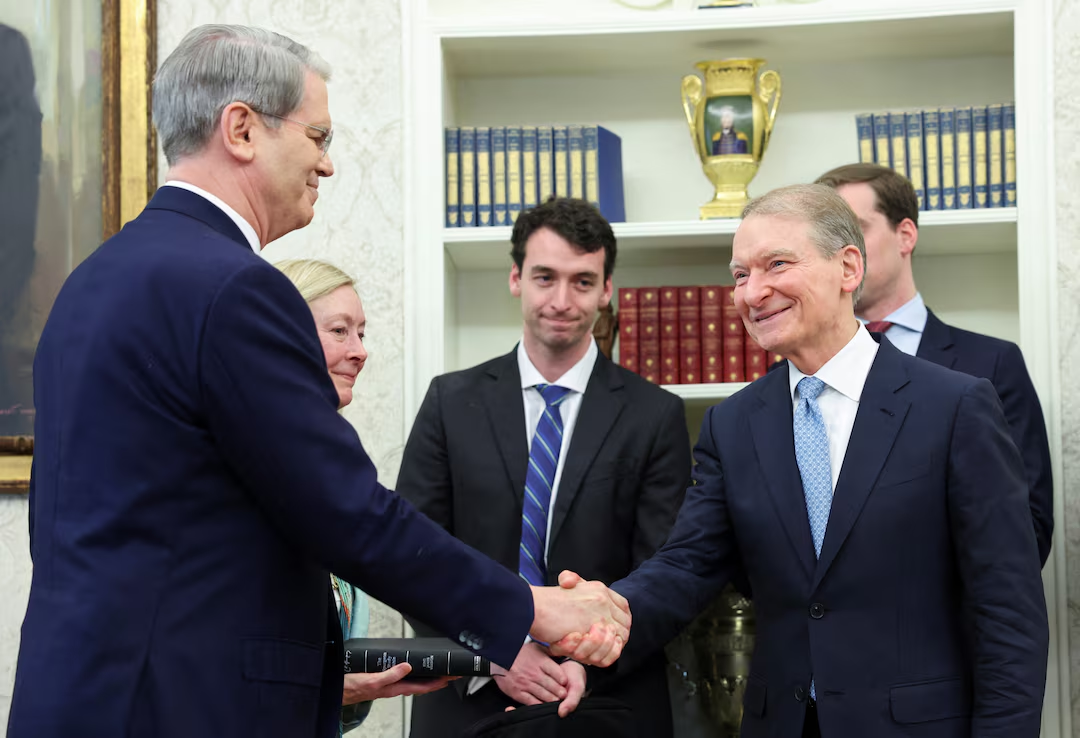
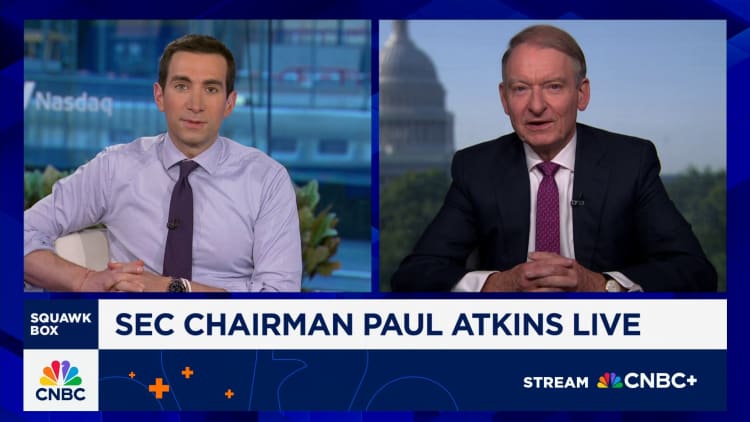
Paul Atkins took the stage in Las Vegas on Monday and did something no sitting Securities and Exchange Commission chair has ever done: addressed the flagship Bitcoin conference. The former Patomak Global Partners co-founder, confirmed as SEC Chair in early 2025, used his keynote to announce that the agency is "on the cusp" of releasing an innovation exemption, a 12-to-36-month regulatory sandbox that allows qualified firms to issue and trade tokenized securities directly on public blockchains and decentralized finance protocols under lighter-touch oversight rather than the full weight of existing securities law.
The timing is deliberate. Six days before Atkins reached the Las Vegas stage, he told Washington Economic Club executives that the exemption is essentially ready. In the same week, data tracked by Volmex and reported by CoinDesk showed that open interest in IBIT, BlackRock's bitcoin exchange-traded fund options listed on Nasdaq, crossed $27.61 billion, eclipsing Deribit's $26.90 billion for the first time. The two data points together trace an arc: U.S. regulated crypto infrastructure has quietly stopped being second-tier, and Washington is moving to formalize that fact with a policy framework that matches the market's structural advance.
The Innovation Exemption's Mechanics

The exemption is the operational centerpiece of Atkins' "ACT" strategy, which stands for Advance, Clarify, Transform, and represents the most concrete policy commitment from the SEC on crypto in a decade. Under the proposed framework, firms that qualify would be permitted to run pilot programs facilitating the trading of tokenized securities on public blockchains for a fixed period, subject to principles-based safeguards rather than full compliance with the Securities Exchange Act's broker-dealer registration regime.
Atkins cited a specific use case that the previous leadership would have treated as legally untenable: a retail investor trading a tokenized position in Apple shares on a DeFi protocol, with settlement occurring at the point of transaction rather than two business days later under the incumbent T+2 clearing cycle. No broker-dealer intermediary. No custodian hold. Near-instant finality.
The exemption does not override existing securities law. Tokenized Apple shares remain securities. What changes is the licensed pathway for intermediaries who want to build infrastructure around them without facing an investigation as their first contact with the SEC. Atkins was explicit about the old model's deterrent effect: anyone who previously tried to engage the agency "often found an investigation waiting for them." The sandbox replaces that dynamic with a supervised build-and-report cycle, where the SEC observes real-world operations before writing permanent rules.
The 12-to-36-month window matters for industry planning. Firms that apply early gain legal certainty; those that wait risk falling outside the exemption period if permanent rules arrive before they launch. Several broker-dealers and DeFi protocol operators, including firms active in the tokenized U.S. Treasury space, are reported to be preparing applications in anticipation of the formal release.
Sixteen Commodities and Four Categories
The innovation exemption arrives downstream of a broader taxonomy project in motion since July 2025. Project Crypto, Atkins' umbrella regulatory reform program, produced a joint interpretive release with the Commodity Futures Trading Commission in March 2026 that formally classified digital assets into five categories. The release represents the most consequential regulatory line-drawing exercise since the Howey test was first applied to tokens.
The five categories are: digital commodities, which include Bitcoin, Ethereum, Solana, and 13 additional layer-one assets now formally recognized as outside SEC jurisdiction; digital collectibles, covering NFTs and tokenized physical objects; digital tools, defined as utility or access tokens including memberships and software licenses; payment stablecoins, assets qualifying under the GENIUS Act's reserve and redemption standards; and tokenized securities, the category over which the SEC retains full jurisdiction.
The last category is the narrowest it has ever been. Sixteen assets were classified as digital commodities in the March release, stripping the agency's historical ambiguity weapon, the threat of retroactive securities classification, from the majority of the liquid crypto market. What remains inside the SEC's perimeter is smaller and more precisely bounded than at any point since the agency first issued guidance on initial coin offerings in 2017.
The CFTC has reciprocally gained exclusive spot-market jurisdiction over digital commodities. That jurisdictional split, previously a source of industry paralysis as firms could not determine which agency to approach, is now codified. Both CFTC Chair Brian Quintenz and Atkins were present at Bitcoin 2026, the first time two sitting U.S. financial market regulators have shared a stage at the conference.
IBIT Crosses $27.6 Billion, Eclipsing Deribit
The regulatory shift coincides with a structural milestone in derivatives markets. Open interest in IBIT options on Nasdaq reached $27.61 billion on Friday, according to Volmex data reported by CoinDesk, surpassing Deribit's $26.90 billion in bitcoin options for the first time since IBIT options launched in late 2024. Deribit has operated bitcoin options since 2016.
The inversion reflects several forces simultaneously. IBIT options are accessible through standard brokerage accounts at Fidelity, Schwab, and Interactive Brokers, rather than requiring a separate crypto exchange account and custody arrangement. That eliminates the compliance friction that kept institutional allocators away from offshore derivatives venues. The onshore instrument also operates under CFTC and SEC oversight, satisfying the mandate requirements of pension funds, insurance companies, and sovereign wealth vehicles that cannot hold positions on unregulated exchanges.
Expiry preference data reveals the underlying holder base. IBIT options skew toward October 2026 expirations on an open-interest-weighted basis, running approximately two months longer-dated than Deribit's dominant August positions. The gap is symmetric across puts and calls, indicating it reflects the investor horizon rather than asymmetric demand for downside protection. ETF holders are running longer-term hedging programs consistent with quarterly or semiannual portfolio reviews, while Deribit's base tilts toward tactical traders managing shorter-duration risk.
Forbes, tracking market reaction to Atkins' Las Vegas speech, noted that expectations for bitcoin to retest the $80,000 resistance level have heated up materially in the 48 hours since the innovation exemption details were confirmed.
Wall Street vs. Offshore: A Structural Divorce
The IBIT milestone is not a zero-sum event. Deribit's total bitcoin options open interest has continued to grow in absolute terms. But the crossing of the two curves signals that U.S. regulated bitcoin infrastructure has achieved critical mass: the offshore venue is no longer the only place institutional money goes to express bitcoin options exposure.
That bifurcation will deepen as the innovation exemption brings tokenized securities onto the same regulated rails. A firm that trades tokenized Treasuries, tokenized equities, and bitcoin derivatives inside a single compliant framework, without crossing into offshore jurisdiction, has less reason to maintain a separate offshore account purely for crypto. The collateral efficiency gains from holding positions in a single prime brokerage margin account represent the structural wedge that Wall Street prime brokers are currently evaluating.
The competitive reshuffle is also between incumbents inside traditional finance. Nasdaq, CBOE, and CME are each positioned to expand their tokenized securities infrastructure if the exemption framework normalizes on-chain trading. Traditional custodians including BNY Mellon, State Street, and JPMorgan have each announced or piloted blockchain-native custody products over the past eighteen months. The exemption converts those pilots from proof-of-concept exercises into commercially viable businesses.
From T+2 to T+0: The Settlement Revolution
The operational consequence that matters most to institutional desks is settlement finality. The U.S. equities market moved to T+1 in May 2024 after years of lobbying, a change that required significant technology investment across brokers, custodians, and clearinghouses. Tokenized securities on public blockchains can achieve T+0, settlement at the time of execution, because the blockchain ledger entry is the settlement record.
That eliminates counterparty risk during the settlement window, reduces the collateral firms must post against unsettled trades, and compresses the operational complexity of fail management. For algorithmic trading operations running high volumes, the capital efficiency gain from T+0 settlement is significant enough to shift profitability thresholds for strategies that currently operate near the margin.
The compliance architecture around T+0 is not trivial to build. Anti-money-laundering and sanctions screening must be embedded at the protocol or application layer rather than applied post-trade during the settlement cycle. The exemption's 12-to-36-month timeline gives firms space to develop those compliance stacks under regulatory observation, without the exposure that came from building first and explaining second. That sequencing, build under supervision rather than build and then litigate, is the operating logic of the sandbox model.
From Enforcement File to Policy Blueprint
The depth of the break with the Gensler-era approach is easy to understate. Between 2021 and 2024, the SEC's primary interaction mode with the crypto industry was litigation: enforcement actions against Coinbase, Kraken, Ripple, Binance, and dozens of smaller token issuers. The agency's theory was that existing securities law was sufficient, and that firms simply needed to register. The industry's counterargument, that the registration pathway did not functionally exist for most blockchain assets, was rejected.
Atkins' framework concedes the structural point without naming it. The innovation exemption exists precisely because the existing pathway was not fit for purpose. The sandbox gives firms a compliant route to market that the prior decade's enforcement posture had closed. The token taxonomy clarifies jurisdiction so that firms know upfront which regulator they answer to, rather than discovering that answer through a Wells notice.
Whether the exemption leads to permanent rulemaking before its window closes remains an open question. A future SEC chair with a different orientation would face a meaningful record of pilot program data to argue against before rolling back the framework. That institutional inertia is built into the design. The sandbox model, used successfully in fintech by the UK's Financial Conduct Authority and Singapore's MAS before Washington adopted it, transfers some of the burden of proof from the firm seeking to build to the regulator seeking to block.
The week Atkins spent preparing his Las Vegas keynote coincides with the week IBIT crossed Deribit. Policy and market structure are moving in the same direction at the same time, which is not something the crypto industry has been able to say for most of its history.
Paul Atkins will face harder questions in the weeks ahead, most of them procedural: which firms qualify for the exemption, what the application process looks like, and whether the sandbox's principles-based safeguards have enough specificity to give compliance teams something to build to. Those questions are legitimate and unresolved. They sit downstream of the shift that took place in Las Vegas, which is that a sitting SEC chair told the Bitcoin conference that the agency's default posture toward the industry is now one of supervised innovation rather than preemptive enforcement. IBIT's overtaking of Deribit in the same week is the market's forward read on the outcome: regulated U.S. infrastructure, given a clear framework and the capital base to match, will compete.