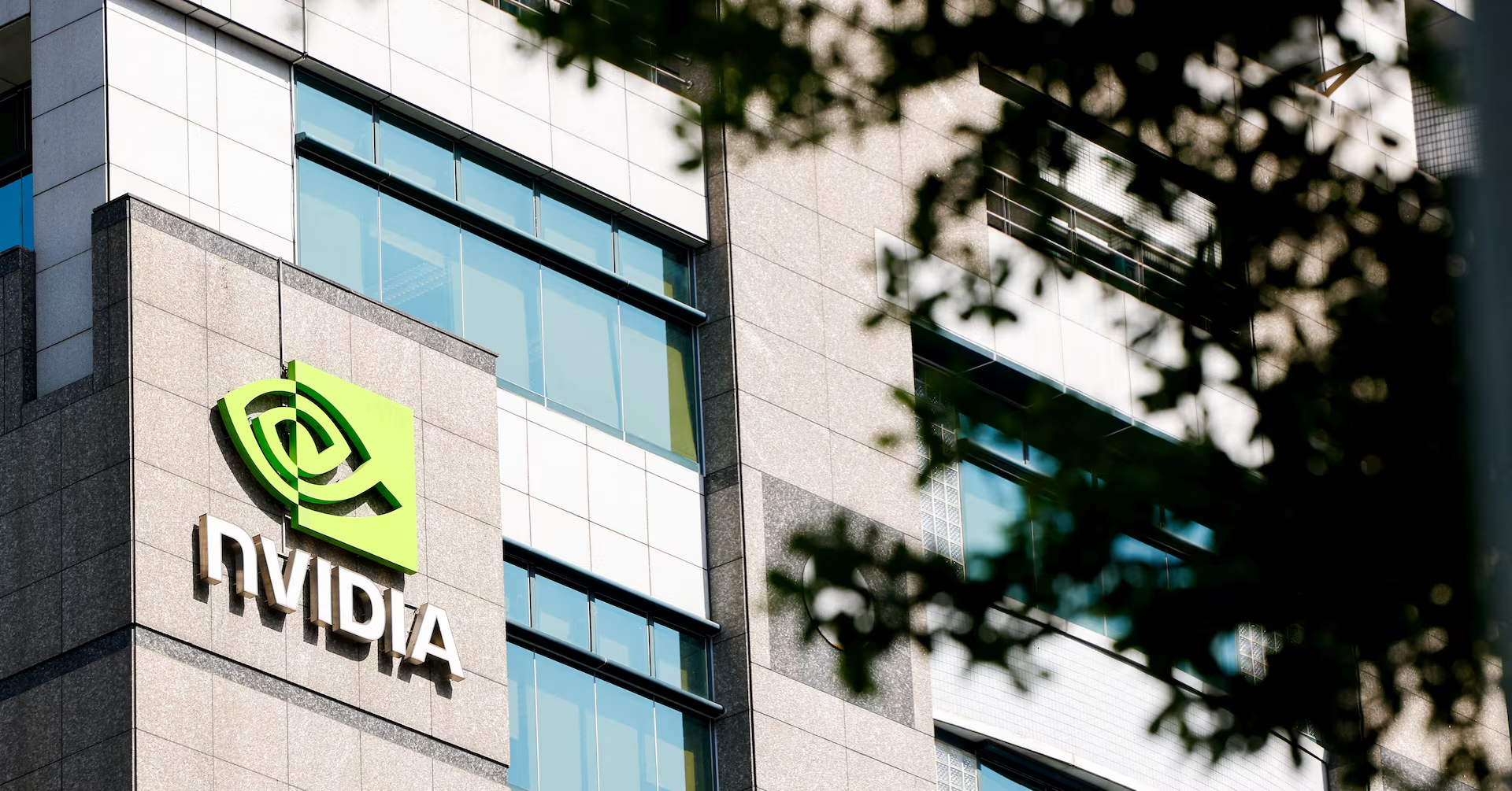
Nvidia said it expects a $5.5 billion charge after the U.S. government imposed a new licensing requirement on H20 chips sold into China, a decision that reaches far beyond one quarter's cleanup. Reuters reported the charge covers inventory, purchase commitments and related reserves, which means the damage sits not just in lost future sales but in products already built, wafers already booked and supply obligations that now have to be revalued. The company designed the H20 specifically for a China market shaped by Washington's October 2022 and October 2023 export controls, after earlier China-compliant parts such as the H800 were also pushed aside. The result is a blunt message to investors and customers alike: the old game of tuning performance down to the letter of the rule no longer guarantees a market. With annualized H20 shipments to China previously estimated at $12 billion to $15 billion, the issue is not whether Nvidia loses a niche line. It is whether one of the world's most important AI products has just become proof that the U.S. export-control regime is willing to follow the workaround itself.
A tailored China chip becomes a balance-sheet charge
The H20 matters because it was never an accidental product. Nvidia engineered it as the latest in a sequence of China-safe accelerators, first adapting to the October 2022 controls and then to the tighter thresholds introduced in October 2023. The chip was supposed to preserve legal access to Chinese cloud and internet groups without crossing Washington's published limits on interconnect and performance. That design logic now looks obsolete. Reuters said Nvidia disclosed that the new licensing requirement forced it to take a $5.5 billion charge tied to inventory, purchase commitments and related reserves, language that captures the full chain of semiconductor planning from wafers to finished systems. In practice, that means the company cannot simply stop shipping and move on. It has to deal with stock already produced, supplier capacity already reserved and customer demand that was real enough to justify those commitments. The significance of that detail is operational, not rhetorical. Export controls used to look like bright lines that companies could model around. Nvidia built H800 and then H20 on that premise. The new action says a chip built to satisfy the threshold can still be stopped if Washington no longer likes the result. Once that happens, compliance becomes less about engineering to a number and more about political durability, which is a much harder variable for any semiconductor roadmap to price in.
The revenue line shrinks, but the larger hit is to predictability
A $5.5 billion charge is manageable for Nvidia in pure balance-sheet terms, but the market consequence runs through visibility. China has been one of the few places on earth where demand for training accelerators remained structurally large even after multiple rounds of U.S. restrictions. Estimates of annualized H20 shipments at $12 billion to $15 billion implied a business sizable enough to matter to revenue growth, factory loading and investor expectations for how much of Nvidia's backlog remained diversified beyond the biggest U.S. cloud buyers. Removing that line does more than reduce sales. It weakens management's ability to tell suppliers how much advanced capacity it needs, and it forces investors to separate reported AI demand from demand that is still exportable. The charge also lands in an awkward place in the income statement. Reuters' description makes clear this is not only a write-down of finished goods; it also reflects purchase commitments already made. That pulls the effect forward. Even if some capacity is redirected to other products, the timing mismatch hurts. The H20 had been one of the cleaner ways for Nvidia to monetize restricted demand without discounting its flagship Blackwell and Hopper lines elsewhere. It also gave the company a way to keep software lock-in alive inside Chinese accounts that still wanted CUDA-compatible infrastructure. Now Nvidia is left with a reminder that growth built on special-purpose compliance SKUs deserves a lower certainty multiple than growth built on unrestricted platforms. For a stock priced on sustained AI scarcity, certainty is almost as valuable as volume.
Huawei and AMD inherit the opening Nvidia spent years defending
The immediate beneficiaries are not theoretical. Bloomberg reported that Chinese groups including Alibaba, Tencent and ByteDance use Nvidia chips for AI training, which means any disruption in H20 availability forces a procurement decision at some of the country's most important compute buyers. Huawei is the obvious local winner. Its Ascend 910B and newer variants have already become Beijing's preferred answer to dependence on U.S. accelerators, and every new export-control round gives domestic buyers another reason to invest engineering time in Huawei's software and systems stack. That matters because semiconductor share does not move only on chip performance. It moves on whether customers are willing to port models, optimize frameworks and commit procurement budgets for several years. Washington just gave that migration effort a fresh shove. AMD also benefits, even if more selectively. Its MI300 and MI325 lines, backed by ROCm, give cloud providers and model developers a second U.S. ecosystem to evaluate when Nvidia supply looks politically fragile. AMD still trails badly in software maturity and developer lock-in, but the strategic pitch improves when Nvidia's China-specific roadmap can disappear by administrative notice. The deeper point is that Nvidia spent years defending China revenue by staying just inside the rules. That defensive strategy kept rivals from owning the restricted market. If the regulatory perimeter now follows each new compliant SKU, Nvidia no longer controls the tempo of substitution. Beijing-backed domestic suppliers and every credible alternative stack get a better chance to turn policy shock into installed base.
TSMC, HBM suppliers and Asian data-center budgets now need a reset
The second-order effects run through the entire AI hardware chain. Financial Times reported that tighter U.S. rules threaten Asian data-center capital-expenditure plans, a point that matters because H20 demand did not exist in isolation. It supported procurement assumptions at Chinese internet groups, regional cloud builders and the suppliers feeding Nvidia's packaging and memory requirements. If annualized H20 volumes really sat in the $12 billion to $15 billion range, those chips were consuming meaningful slices of TSMC advanced-node output, high-bandwidth memory supply from SK Hynix, Samsung and Micron, and CoWoS packaging capacity that has been one of the industry's main bottlenecks. A licensing wall does not erase demand for compute in China, but it does scramble who gets the orders and what kind of hardware fills the racks. That creates inefficiency throughout the chain. TSMC has to think about whether China-targeted wafer starts can be redirected smoothly to unrestricted Nvidia products or to other customers altogether. Memory suppliers must decide how much HBM allocation still belongs with Nvidia versus alternative accelerator programs. Asian data-center operators, meanwhile, have to revisit capex timing if the chip they expected to deploy now needs a license with no clear approval path. Bloomberg's identification of Alibaba, Tencent and ByteDance also points to a more practical disruption: these buyers are not purchasing a single board at a time, but planning clusters, networking gear, power budgets and software teams around known accelerator roadmaps. If the H20 drops out, the rack design changes, the training economics change and the procurement calendar changes. The disruption also reaches beyond China. If Nvidia reallocates capacity intended for H20 into other regions, it can tighten supply in some segments and loosen it in others, changing prices for enterprises that had nothing to do with Chinese demand. Export controls are now setting not just who buys top-end AI chips, but how the industry's most constrained manufacturing resources are distributed.
Washington is now policing the SKU, not just the threshold
The policy message is the most consequential part of the episode. The H20 was born from a regulatory philosophy that looked mechanical: set a performance threshold, let companies redesign products below it, and accept the commercial result. That framework produced a cat-and-mouse cycle, but it still left room for planning. What this week's action signals is a shift from threshold enforcement to product enforcement. In other words, Washington is no longer satisfied when a company says a chip meets the published line. It is asserting the right to revisit the chip itself if the commercial or strategic outcome still looks too permissive. That is a meaningful change in the export-control regime because it narrows the value of clever engineering workarounds. It also raises the compliance burden for every company selling advanced compute into sensitive markets, whether the vendor is Nvidia, AMD or a future custom-silicon supplier. The old question was technical: how much bandwidth, interconnect and performance can a product carry before it triggers a ban? The new question is strategic: will regulators tolerate this SKU at all once it becomes important? That ambiguity is deliberate. It tells Beijing that substitute access through product tailoring will face a shorter leash. It also tells the industry that U.S. policy is becoming more discretionary at the exact moment AI infrastructure spending is becoming more central to corporate strategy and national industrial policy. That matters for capital allocation inside Nvidia as well. Engineers can still design around published rules, but finance teams now have to ask whether those products deserve the same wafer reservations, software support and go-to-market effort as chips sold into unrestricted markets. Once a government starts judging the workaround rather than the specification, every future China-specific accelerator carries a higher risk premium on day one.
Nvidia will survive a $5.5 billion charge. The harder adjustment is that one of its most carefully constructed geopolitical products has stopped being a reliable bridge between U.S. technology leadership and Chinese demand. That changes how investors should read every future "compliant" chip announcement. It changes how Chinese cloud groups think about software portability and domestic alternatives. And it changes how suppliers from TSMC to SK Hynix think about which demand signals deserve long-cycle commitments. The real lesson is not that export controls got tighter again. It is that Washington has moved to a regime where compliance by specification is no longer enough if the policy outcome still leaves China with too much usable AI compute. Once that principle takes hold, every workaround carries a shorter shelf life, every special SKU earns a discount, and every rival positioned on the other side of the restriction gets a more credible opening. The next phase of the AI chip race will be shaped less by who has the fastest silicon than by who can build a business that survives policy discretion as well as technical competition. That is a harsher environment for Nvidia, but also a clearer one for the rest of the market. Investors, suppliers and customers now have a concrete number for the cost of regulatory improvisation, and it is large enough to change behavior well before the next rule is published.