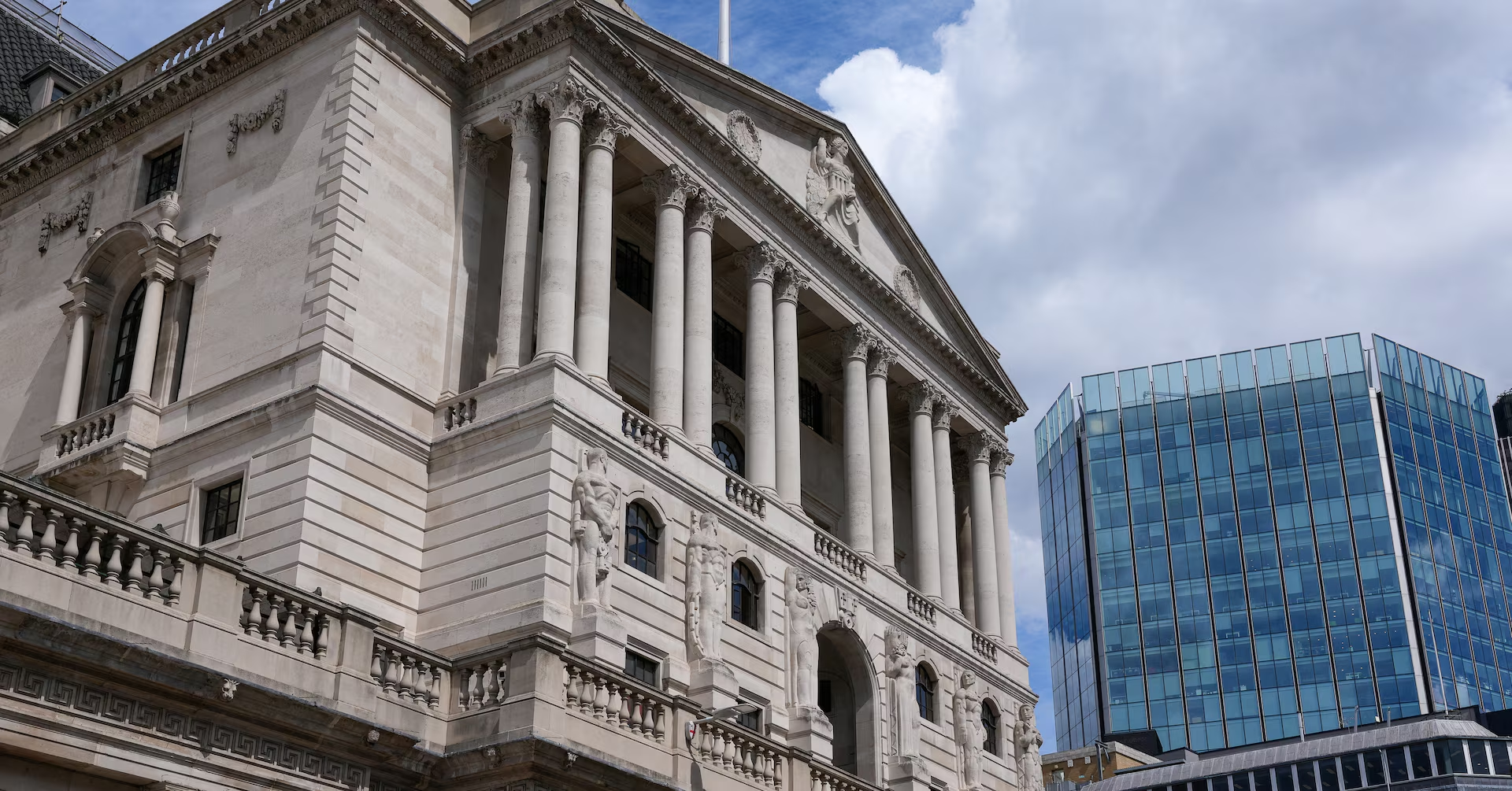
The signal was unusually direct. Sarah Breeden, deputy governor for financial stability at the Bank of England, told the BBC last week that global equity markets are overvalued and that investors should expect a correction. "There's a lot of risk out there and yet asset prices are at all-time highs," Breeden said. "We expect there will be an adjustment at some point."
Central bankers calibrate language to avoid triggering the events they warn about. Breeden dispensed with that convention: she named the direction, treated the outcome as a baseline assumption, and reframed the Bank of England's role accordingly. "It's ensuring that if it happens the system is resilient," she said. That posture — candid about the outcome, agnostic about the timing — represents a deliberate departure from the studied opacity that has defined financial stability communication for years.
The timing matters. The S&P 500 has touched record levels in 2026, Goldman Sachs just posted its second-highest quarterly revenue on record, and public markets have been behaving as though the geopolitical disruptions of the past twelve months have been resolved. Breeden's warning is that comfort is misread, and that three distinct risk categories are now aligning simultaneously in a configuration that the Bank of England finds genuinely alarming. Her comments, delivered in a national broadcast and picked up by CNBC and other financial outlets, are among the most direct public statements from a sitting G7 central bank official in recent years.
How Central Banks Warn Without Triggering
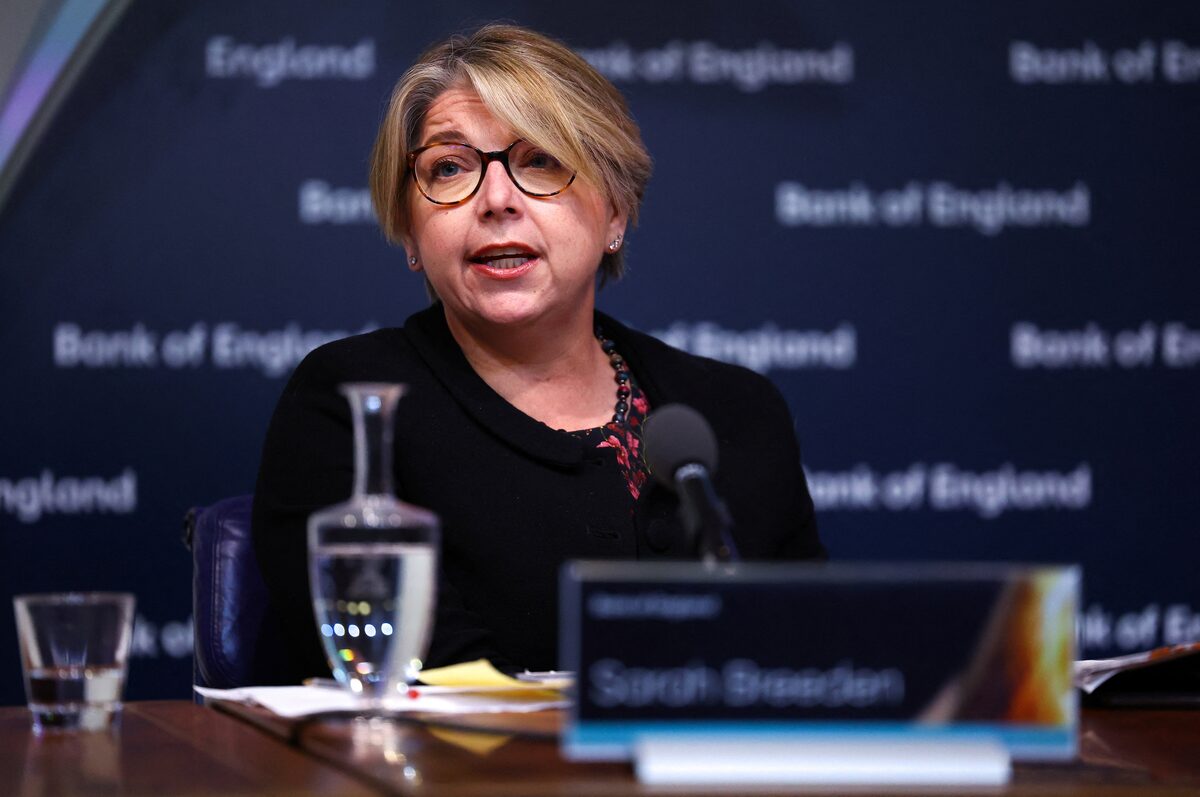
Financial stability officials operate in a narrowing corridor between transparency and market-moving language. Saying that markets will fall risks accelerating the sell-off they are preparing for. Saying nothing, as the pre-crisis period of 2006 to 2008 demonstrated, can be characterized later as neglect or willful blindness. The conventional resolution is qualitative language that gestures toward risk without naming a direction: "elevated valuations," "pockets of vulnerability," "concentrated exposures."
Breeden did not reach for that language. Her BBC interview treated the correction not as a scenario under consideration but as an expected event whose timing is unknown. The distinction is meaningful. A scenario under consideration implies low probability and ongoing monitoring. An expected event implies the Bank has already stress-tested it, has already set capital buffer requirements around it, and is now communicating to markets that they should do the same.
The last instance most observers point to as comparable was the Bank for International Settlements' repeated pre-2018 warnings about leverage and valuation risk — statements that were widely noted but insufficiently acted upon, and that looked prescient in the subsequent correction. Breeden's comments place the Bank of England in a structurally similar position: more willing than usual to name the vulnerability, less willing than ever to wait for events to prove the point.
Three Risks the Bank of England Has Quantified
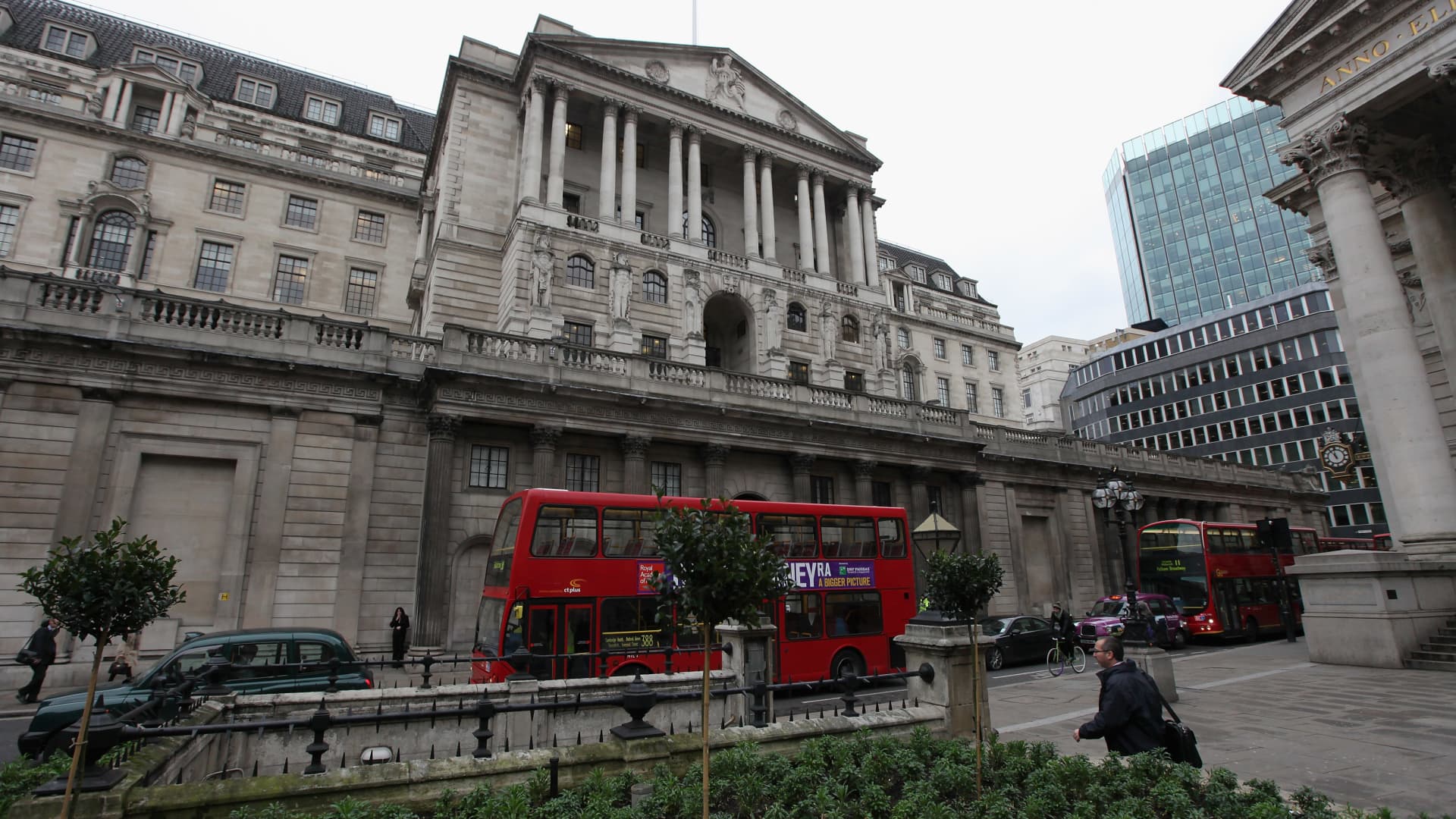
The Bank of England's Financial Policy Committee, which Breeden oversees, has formally identified three categories of systemic risk heading into the second half of 2026: AI-related equity valuations, private credit, and sovereign debt markets. In her BBC interview, Breeden specifically cited the scenario in which "a major macroeconomic shock, confidence in private credit goes, AI and other risky valuations readjust" — not as three separate tail risks but as three events that reinforce each other in the same time window.
The convergence is the key word. Each risk category is present in every annual financial stability assessment at any point in the cycle. What changes the analytical posture is when two or three categories approach stress thresholds simultaneously, because the interactions between them can amplify a shock beyond what any single factor would produce in isolation. The FPC's current assessment is that AI valuations, private credit opacity, and sovereign debt levels are all elevated, and that the correlations between them are positive rather than diversifying.
On AI specifically, the Bank's December 2025 Financial Stability Report noted that valuation multiples for US technology companies focused on artificial intelligence had risen close to levels observed at the peak of the dot-com bubble in 2000. That comparison is calibrated, not rhetorical. The dot-com peak was followed by a 78 percent decline in the Nasdaq Composite over 30 months, and full recovery took more than a decade. The Bank is not predicting a repeat, but it is using the precedent as a stress calibration — one data point from which to derive what a severe-but-plausible adverse scenario looks like.
Private Credit's $2.5 Trillion Blind Spot
Breeden's comments on private credit were the most detailed she offered. "It has gone from nothing to two-and-a-half trillion dollars in the last 15 to 20 years," she said. "It hasn't been tested at this scale with the degree of complexity and interconnections it has with the rest of the financial system so far." That sentence contains the operational concern: not that private credit is fraudulent or mismanaged, but that it has grown to systemic scale inside an extended low-rate environment and has never experienced a genuine credit cycle.
Private credit funds are not required to mark assets to market daily. Valuations are updated quarterly, with appraisals often conducted by the fund manager or affiliated parties. During periods of deteriorating credit quality, this creates a lag between what is happening on the ground and what shows on investor statements. The lag can extend to six months in funds with less frequent reporting. When the lag resolves — when write-downs are recognized, often in a cluster — redemption pressure can hit multiple funds simultaneously.
Banks are exposed to that dynamic through several channels: direct loans to private credit funds, co-investment arrangements, risk-transfer structures, and lending to the corporate borrowers that private credit funds have financed. A private credit dislocation would not stay confined to alternative asset managers. It would propagate through bank credit books at exactly the moment when banks are absorbing equity market losses and sovereign debt repricing.
The IMF noted in its April 2026 World Economic Outlook that a private credit shock has "the potential for a contained systemic impact," a formulation that acknowledges both the risk and the uncertainty about how it propagates. JPMorgan Chief Executive Jamie Dimon offered a more reassuring read in his annual shareholder letter, writing that private credit "probably does not present a systemic risk." The gap between the two assessments reflects the difference in vantage point. Banks with large lending and prime brokerage exposure to the sector have institutional reasons to frame the risk as manageable. Regulators with no revenue stake do not.
AI Valuations at Dot-Com Levels
The AI valuation concern operates through a structural financing channel that goes beyond equity prices. The Bank's analysis notes that AI companies are increasingly funding infrastructure through debt rather than equity, because the capital requirements — data centers, power infrastructure, custom silicon — have outpaced what equity markets can absorb at current multiples without severe dilution. The Bank's estimate places AI infrastructure spending globally over the next five years above $5 trillion, a significant portion of which will be debt-financed.
The implications are direct. Banks are exposed to AI companies through revolving credit facilities, term loans, and project finance structures. They are also exposed indirectly through their lending to private credit funds that have built concentrated positions in AI-adjacent software and infrastructure businesses. If AI valuations correct — driven by rising rates, a sustained miss on earnings, or a geopolitical disruption to chip supply chains — the losses flow through both channels simultaneously.
The valuation multiples on the largest US AI-focused technology companies imply earnings growth sustained at rates that have been achieved only in narrow historical windows. The BoE does not suggest this growth will not materialize. It does note that the market is assigning very little probability weight to the scenarios in which it does not — and that stress-testing frameworks, by design, exist to price those scenarios.
Markets at Record Levels Despite the Warning
The backdrop to Breeden's comments is a global equity market that is performing as though the risks she is cataloguing have already been priced and resolved. Goldman Sachs reported first-quarter 2026 revenues of $17.23 billion, the firm's second-highest quarterly total on record. Investment banking fees climbed 48 percent to $2.84 billion, driven by advisory revenue that jumped 89 percent year-over-year to $1.5 billion. Equities trading revenue rose 27 percent to $5.33 billion, supported by rising financing activity in its prime brokerage business. US technology stocks have gained more than 11 percent month-to-date in April.
The S&P 500 extended its record run following President Trump's announcement of a ceasefire extension with Iran. The index added more than 1 percent on the day, with the Nasdaq gaining 1.64 percent. The market read was that the primary tail risk — a wider regional conflict and associated oil supply disruption — had been reduced. That reading is not unreasonable. But Breeden's framework offers a different lens: a ceasefire removes one trigger while the underlying valuation structure remains unchanged. "There's a lot of risk out there and yet asset prices are at all-time highs," she said. The combination she is describing — compressed risk premia, multiple latent vulnerabilities, and relief from a single visible threat — is precisely the environment in which the eventual shock, when it arrives, produces corrections larger than expected.
Policy Architecture and the Resilience Mandate
The Bank of England's financial stability mandate is not to predict crashes or time market cycles. It is to ensure that when a correction occurs — in equities, in private credit, in sovereign debt, or in some combination — the domestic financial system absorbs the stress without a systemic crisis. Breeden's comment about "ensuring the system is resilient" is the operational statement of that mandate, not a hedge against being quoted.
What that mandate produces in practice includes countercyclical capital buffers for banks, stress tests calibrated against severe adverse scenarios, regular publication of the Financial Policy Committee's risk assessments, and the kind of public communication that Breeden deployed last week. The public warning function is the least mechanistic of these tools and perhaps the most influential. When the Bank of England's deputy governor says on national broadcast that equity markets are overvalued and will correct, that statement shifts the information environment for institutional investors, corporate treasurers, and pension fund managers who hear it. Whether they act on it depends on their own frameworks and incentives.
The current configuration is the one that financial stability frameworks were built to assess: record equity prices, a $2.5 trillion private credit sector operating on quarterly marks, AI valuations near the dot-com peak, and a geopolitical backdrop that remains volatile despite the ceasefire. Breeden's warning is that the Bank of England's assessment of that configuration is not reassuring. The system has not been tested at this combination of scale and interconnection before. The Bank's job is to make sure that when the test comes, the financial system's answer is adequate.