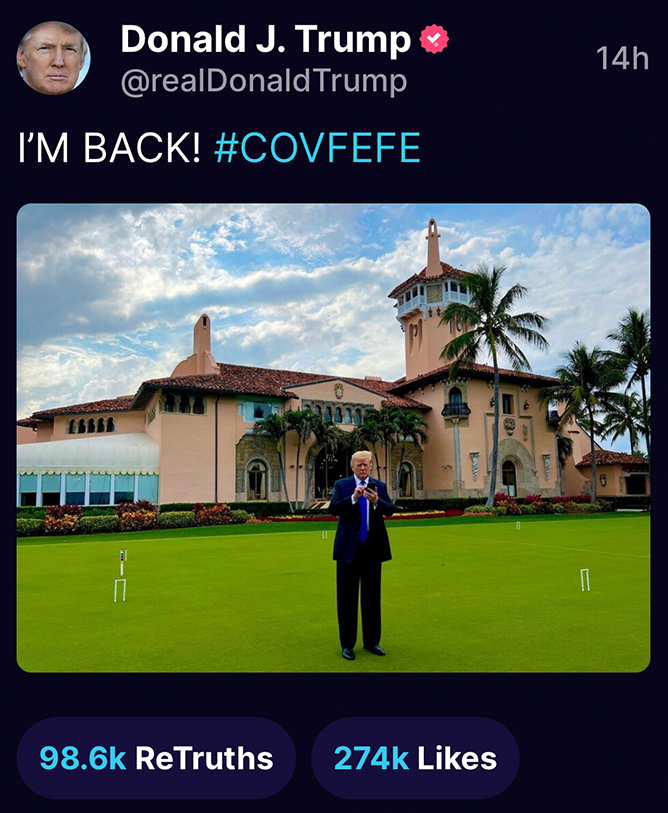
A single social-media post has, for fifteen months, been sufficient to move the S&P 500 Index more than a Federal Reserve statement, a jobs report, or an earnings release. Bloomberg published an analysis on April 25, 2026, drawing on Fundstrat Research data that quantified what traders already felt: Donald Trump's comments to reporters, posts on Truth Social, and extemporaneous remarks at Oval Office press sprays have driven every one of the five best days and every one of the five worst days in the S&P 500 since he returned to office in January 2025. No administration has produced a similar concentration across a dozen presidencies going back to Ronald Reagan, according to the Fundstrat data. "He has the market in a chokehold," said Hardika Singh, economic strategist at Fundstrat. The statement is not a political observation; it is a structural one. Professional investors have spent fifteen months re-engineering their risk systems, their option books and their trading algorithms around a single social-media account and the unpredictable cadence of White House briefings. That structural adaptation is now producing its own secondary effects: a named strategy, the TACO trade, has gone from a Wall Street wisecrack to one of the most-discussed macro frameworks in institutional investing, and the Iran conflict is delivering the first genuine test of whether the playbook breaks down when the counterparty is not a trading partner with quarterly GDP pressure of its own.
How One Account Moves Prices Faster Than a Central Bank
The mechanism connecting Trump's posts to market prices is operationally established by now. Algorithmic trading desks, macro hedge funds and even retail platforms have built scanning tools that flag Truth Social updates, press-conference captions and wire headlines within milliseconds of publication. The speed of that reaction has compressed the gap between a presidential statement and a market price to something closer to what was previously reserved for Federal Open Market Committee decisions. Barclays strategist Andreas Altmann argued in a note cited by Bloomberg that the overall magnitude of market volatility under Trump's second term has not risen dramatically relative to past administrations once standard deviation is controlled for. What has changed, Altmann wrote, is the delivery medium: high-cadence social media produces sharper intraday spikes than old-style press conferences or formal policy announcements, even when the eventual close-to-close price move lands within a historically normal band. That framing matters for risk managers because it distinguishes the character of volatility from the quantity of it. Intraday swings of 2% to 3% on a single post can force stop-losses and margin calls even when the day-over-day close is modest. Options desks adjusted by widening bid-ask spreads around the times Trump is most active online, typically morning hours Eastern time, when Truth Social posts have historically preceded market-moving announcements by minutes.
The fastest V-shaped drop and recovery in the S&P 500 since 2020 illustrates the dynamic in compact form. The index fell roughly 9% from a January 27, 2026, peak to the cusp of a technical correction on March 30, before recovering fully to all-time highs across eleven trading sessions. The sell-off tracked a sequence of White House signals about escalation in the Iran conflict. The recovery tracked a sequence of ceasefire hints. No earnings release, no inflation print and no Fed communication drove either leg. The market was pricing the president's next statement.
The Price Tag on Each Announcement
The five best and five worst days in the S&P 500 since January 2025 produce a compact ledger of what Trump's policy announcements are worth in index points. On April 9, 2025, the index gained 9.5% after Trump announced a pause in his sweeping tariff regime. On May 12, 2025, it gained 3.3% when the United States and China agreed to a 90-day trade truce. On the downside, the index lost 6% on April 4, 2025, after China announced retaliatory tariffs, and fell 4.8% on April 3, 2025, after Trump first implemented the levies. All of those moves were concentrated in single sessions, driven by a single announcement, and reflected a magnitude that would typically require either a financial crisis or a major geopolitical rupture to produce in prior administrations.
The Iran conflict has added a new row to the ledger. The S&P 500 fell approximately 4% from its peak in the weeks following the outbreak of hostilities in late February 2026. When Trump announced an indefinite ceasefire on April 8, 2026, the Nasdaq Composite jumped 3.55% and the S&P 500 gained 2.7% in a single session, according to CNBC. The S&P 500 finished the week of April 25 at 7,165.08, up 0.8% on the day and within range of its all-time high, as investor hopes for formal peace talks in Pakistan emerged. Through April 20, the index was up 4.23% for the year, a figure that would look considerably weaker without the post-ceasefire rally and the prior tariff-truce momentum.
TACO Becomes an Institutional Operating Framework
Financial journalist Robert Armstrong named the TACO trade on May 2, 2025, almost exactly one year before Bloomberg's chokehold analysis. The acronym stands for Trump Always Chickens Out. The thesis is that Trump uses extreme policy threats as opening bids in a negotiation, and that his instinct to avoid sustained equity-market damage produces a climbdown before fundamental damage accumulates. Investors who buy the dip on escalation get paid when the off-ramp arrives. The April 2025 tariff pause and the May 2025 trade truce were TACO's first confirming data points. The April 8, 2026, Iran ceasefire announcement became widely cited as the most lucrative single TACO trade of the year for funds that had stepped into the market during the conflict-driven sell-off.
The strategy has moved from informal heuristic to institutional framework with unusual speed. Macro hedge funds have allocated capital to explicit TACO-adjacent positions: long equity volatility into escalation events, long the index on the dip, short volatility after the resolution arrives. The Benzinga analysis published on April 25 noted that TACO had ceased to be a joke and was now an operational strategy for several large funds trading U.S. equities in size. The entry cost to running a TACO book has risen as the trade became crowded, compressing the returns available when resolution comes. That crowding creates a feedback loop: the more funds positioned for a Trump climbdown, the sharper the rally when it materializes, which in turn confirms the framework and draws additional capital into it. That self-reinforcing dynamic is part of why the S&P 500's post-ceasefire moves in April 2026 were larger than the pre-conflict sell-off alone would have warranted.
The Iran Conflict Tests a Structural Assumption
The tariff fights of 2025 gave TACO its initial credibility because both sides in those negotiations shared a preference for an eventual resolution that preserved economic activity. A trading partner under tariff pressure loses export revenue; the United States loses import-cost stability; both parties gain from agreeing to reduce barriers. TACO worked in that context because the game had a cooperative equilibrium that both players preferred to sustained conflict.
The Iran conflict introduces a different structure. Iran's government does not face the same quarterly earnings pressure or equity-market discipline that constrains American policy choices. A ceasefire reduces oil-price pressure and restores equity-market calm for the United States, but Iran's strategic calculus operates on a different political clock. Analysts at Fortune and the Japan Times noted in April 2026 that TACO carries a hidden assumption: that both sides want out of the confrontation once it becomes economically painful. When that assumption breaks down, the trade converts from a negotiation-theory arbitrage into a directional bet on American political will alone. The oil spike to $96.50 per barrel for West Texas Intermediate last week reflects a market that is not fully pricing in a durable peace. The International Monetary Fund, in its April 2026 World Economic Outlook, used a baseline assumption of a 19% increase in energy-commodity prices in 2026 even under a short-lived conflict scenario, projecting global growth at 3.1% and headline inflation at 4.4%. Those numbers represent the floor if TACO holds; the ceiling, if sustained hostilities resume, sits considerably higher on the inflation axis and lower on the growth one.
What the Fed, Funds and Foreign Holders Do With This
The structural dependency of equity-market returns on one social-media account creates novel problems for institutional risk managers who were trained on economic fundamentals, not executive posting behavior. Pension funds and sovereign wealth vehicles running long-horizon mandates do not typically model presidential Truth Social activity as a first-order input into asset-allocation models. The Fundstrat data forces that conversation. If the five best and five worst days since January 2025 are all driven by one person's communications, and if that person's next statement is harder to predict than a Fed dot plot or an ISM print, then traditional volatility frameworks that treat equity risk as a function of economic fundamentals are structurally incomplete.
The Federal Reserve faces a version of the same problem. Jerome Powell has signaled that the central bank responds to sustained economic conditions, not single-session market moves. That is correct as a statement of policy doctrine. But a market that draws 9.5% daily gains and 6% daily losses from executive announcements the Fed does not control, and that can swing from technical correction to all-time high in eleven trading days, creates an environment where monetary-policy signaling competes with the White House's social-media feed for the dominant variable in daily price formation. Foreign institutional investors add a third dimension. Central banks and sovereign funds in Asia and Europe that hold large U.S. equity and Treasury positions have begun integrating Truth Social monitoring into their real-time risk systems, according to Bloomberg and Reuters reporting from early 2026. The United States equity market has become, for those institutions, a market that prices geopolitical improvisation as much as it prices corporate earnings.
The Fundstrat analysis, and the Bloomberg article that broadcast it on April 25, will not be the last word on this phenomenon. The coming week delivers earnings from several of the mega-cap technology companies that dominate the S&P 500's index weight, including Microsoft, Alphabet, Meta and Amazon, all of which are spending heavily on AI infrastructure while also managing energy-cost exposure from the Iran conflict. Those results will move individual stocks and sector weightings in ways that matter for the index's medium-term direction. But they will compete for primacy in daily price formation against the next Truth Social post, the next Oval Office press spray and the next ceasefire update from the Pakistan channel. In that competition, the Fundstrat data confirm that the policy channel has lately outrun the earnings channel in determining the index's largest single-session moves. The structural question that follows is whether an equity market that derives its most extreme daily returns from one official's communications retains the pricing credibility that pension systems, sovereign funds and foreign central banks depend on. That question will not resolve this week. But it is now asked openly in risk-management meetings in New York, London and Singapore, which is itself a change from twelve months ago, when TACO was still a punchline.